Shia Labeouf Make America Great Again
Artistic Differences
Artistic Differences
"He Will Not Split up Us" posited that nosotros could all get along—but instead became a petri dish of American division.
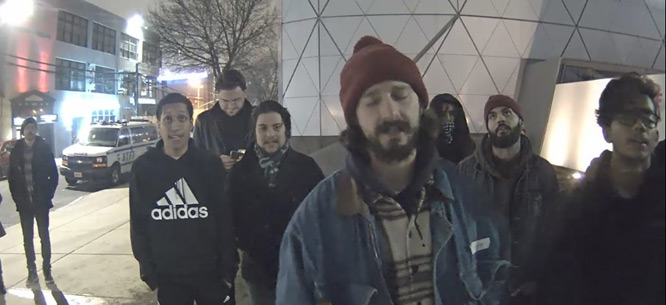
As a piece of political art, "He Will Not Carve up Usa" started out anodyne plenty. On Jan 20, the day of President Donald Trump'due south inauguration, the creative team LaBeouf, Rönkkö & Turner—which includes the child star turned action hero turned performance creative person Shia LaBeouf and his collaborators Nastja Säde Rönkkö and Luke Turner—unveiled a livestreaming webcam embedded in a wall outside the Museum of the Moving Image, in Queens, New York. "He Will Non Divide Us" was written higher up the camera in big cake messages, and visitors were invited to echo the phrase, mantra-like, into the lens. The footage would be streamed online, at hewillnotdivide.us, continuously for four years, until the end of Trump's outset term.
If you've heard anything about "He Volition Not Split up Us," you've probably heard that LaBeouf got arrested, about a calendar week after it opened, for getting into a scuffle with 1 of the pro-Trump agitators who flocked to the piece. Maybe y'all've seen the video of the altercation (he had a few) that plain led to the arrest: a man asks for a selfie, but then says "Hitler did nothing wrong," and LaBeouf shoves him and walks away. Or mayhap yous've seen the video of LaBeouf being handcuffed every bit people keep to chant "He volition not divide the states" cultishly, looking doped out but intent, as he'southward led to the cop motorcar.
On February x, three weeks later on it was turned on, the camera went night. The museum released a statement saying that the installation had "created a serious and ongoing public safe chance." A number of arrests and threats, which had led to around-the-clock police presence, the statement continued, contributed to the conclusion. The artists released their own statement, blaming the museum, without much explanation, for its "misleading framing of our piece every bit a political rally, rather than as a participatory performance artwork resisting the normalisation of sectionalization." The projection, they appear, would be moved to Albuquerque, New Mexico. This turned out to exist the commencement of three moves that preceded the artwork's sputtering and obviously last shutdown, on March 22.
"He Will Not Divide Us" posited that Americans just needed to come together and recognize the ultimate superficiality of their political differences in order to notice unity. Instead, information technology took mere days for the piece to become a petri dish of sectionalisation, growing into both a target for Trump's most trollish supporters and an object of devotion for his most unmoored opponents. In the course of its slow and spectacular implosion, "He Will Non Carve up The states" inadvertently became a much more interesting piece of art—precisely by demonstrating the limits of empty calls for unity.
I visited the installation while it was in the greyness-gravel lot backside the Museum of the Moving Prototype on a freezing winter morning this past January. Chants of "He will non divide u.s.a." were audible from a block away, swinging along with the sing-song cadency of a armed forces Jody call.
The lot was cordoned off by metal oversupply-control barriers, with a museum employee stationed at each entrance. Nigh a dozen people were milling around inside—a relatively tedious day after a rowdy calendar week. There was a mood of dervish-like surrender among the chanters every bit the phone call and response went on and on—ten minutes, fifteen minutes, twenty, and longer. It would continue until someone, usually a homo, approached the camera considering he had something to say. "Alternative facts," 1 of them said, grasping a Starbuck's iced coffee past the chapeau. "There'due south no such thing." Some other, addressing Trump, said, "Merely apologize to the world. That's all y'all gotta do." Sometimes the speakers would form a slow-moving eddy around the camera, tag-teaming their insights until, depleted, i of them would start chanting "He will not carve up u.s." for some other spell.
One young woman had come alone from Massachusetts because she wanted to "be with people who experience the aforementioned" about the political situation. (She hadn't heard nigh the big protests against Trump'south travel ban happening in Manhattan that day.) A human being had travelled from upstate New York with a graph of unemployment rates since 1982, which he held up to the camera in hopes of educating viewers. A couple who lived nearby, in Astoria, were regulars—he'd visited five times since the piece opened and she'd been at that place four times. (Nobody I talked to was peculiarly a fan of LaBeouf.) The man from Astoria had earlier pointed out to the photographic camera that "It doesn't say 'Trump will not divide us.' 'He' could be anybody." He said he came because he disagreed with Trump and he was tired of political leaders "injecting detest and fear into the people." The installation showed that "We can work on things together," he said. "White, hispanic, black, Asian. We accept to piece of work on everything together."
Every bit nosotros spoke, the guy with the Starbuck's cup lectured to the photographic camera virtually why Trump's wall wouldn't work. The Astoria human being would sometimes lose his railroad train of thought, watching him hold forth. "That guy is so . . . " he shook his head, searching for the word. "Opinionated."
Meanwhile, a small grouping formed exterior the barrier—Trump supporters whom the museum employees wouldn't allow inside. The barriers were erected after the site had become chaotic the week before. You could run across information technology on the stream: mayhem as people, speaking in the densely allusive lingo of right-wing internet trolls, leaned into the camera to invoke the meme god Kek or to chant "make America great again," while the true believers, surrounding them, either tried to engage them with lamb-eyed earnestness or shouted "Fuck off, Nazi" repeatedly in their faces. The original artists' statement called the piece an experiment in "resistance or insistence, opposition or optimism, guided by the spirit of each individual participant and the community." Perhaps they didn't anticipate that some of those participants might non approach the project in a spirit of good faith, or that some of them might be neo-Nazis. Regardless, museum security guards and the law began to intervene, then the barriers went up.
Almost vocal amid the exiles was a man in a camo-print hat who goes by the name Baked Alaska. A Trump supporter and a right-wing net celebrity, he'd come from California to exist on the camera (information technology had become the large event of the moment in certain corners of the internet). Only, having been banned, he seemed to relish the opportunity to point out the irony that "He Will Not Dissever United states" had put up a fence. Over the barrier, Baked Alaska and the people inside debated a litany of incendiary topics: Richard Spencer, Nazism, Pizzagate, refugees, terrorism, pedophilia, and the relative perfidy of diverse media outlets. Facts were sparse, as Baked Alaska touted arguments and theories that you might find on conspiracy-minded "alt-right" websites, and those inside reeled with incredulity at his outrageous statements, but struggled to counter them. They had a brief argument nearly who, between the 2 sides, had taken the ruddy pill and who was still stuck in the Matrix.
Through all this, Baked Alaska would occasionally draw anybody'southward attention to how great it was that they could talk to each other despite their differing views. This was something anybody could agree on with enthusiasm. Those inside seemed to see information technology as testify for the unbreakable unity trumpeted by the slogan they'd been chanting. Those outside smirked at the acknowledgement that they were not the problem.
In that location was a fellow continuing near Baked Alaska who was dressed like he'd stepped out of a film from the 1940s: a shearling bomber jacket, wire-framed glasses, and hair slicked down to 1 side. He was adolescent and very polite. I asked about his politics, and he started by saying, "I don't believe we should take an all-white country, just I am a Western cultural chauvinist." Hours after, on the livestream, he was shouting "Remove the roaches!"
Many of the antagonists that plagued "He Will Not Divide Us" came from the cultural stew of the Politically Incorrect, or /politico/, message board on the website 4Chan, which serves as a home base for online trolls and shitposters—people who purposely provoke, confuse, and offend, and are equal parts villain and twerp. 4Chan users hacked Trayvon Martin's email account subsequently his death and were behind the misogynistic harassment campaign Gamergate. The site was as well responsible for co-opting the cartoon Pepe the Frog equally a semi-ironic icon of white nationalism, which led to the frog being condemned as a hate symbol by the Anti-Defamation League during the 2016 ballot. A principal tenor of /pol/ is disdain for uninitiated normies, do-gooder S.J.Due west.due south (social-justice warriors), libtards, and anyone else they deem as well naïve or optimistic; 4Chan trolls similar to dance the thin line between being neo-Nazis and interim like neo-Nazis just to ridicule those they manage to dupe. Trump was /politico/'south chosen candidate as much for the nihilistic "lulz" his victory would inspire equally for his politics.
Almost as presently as "He Will Non Dissever Us" opened, /politico/ identified it every bit a target and started plotting ways to disrupt it. At its most anarchic moments, "HWNDU" (pronounced "Whindoo," as information technology came to exist known in 4Chan circles) was similar a /pol/ thread come up to life. It's petty wonder that the piece—a feel-good, political art installation, open to the public, by a Hollywood star known for getting also large for his artistic britches—attracted the aggressive pessimism of the trolls. Information technology's more surprising that the piece attracted as many devotees as information technology did—people who would show upward whether LaBeouf was there or not, stay for hours, and deliver heartfelt speeches or chant endlessly into the camera no affair what chaos was unfolding around them. Maybe they were just there to be on camera. Or perhaps they got caught up in the high-stakes politics of the Trump era and weren't aware of any better outlet for their anxieties.
When the camera went live in Albuquerque, on an exterior wall of the El Rey Theater, on February 18, LaBeouf was standing to the side and a crowd had gathered around, many of them with their hands folded and heads bowed. A woman standing forepart and centre started repeating "he volition not divide us," taking long pauses and sometimes closing her eyes. Eventually information technology turned into a group chant, which went on for more than an hour. The mood fluctuated between meditative, exuberant, and belligerent; a sort of communal joy arose fifty-fifty as the words, through repetition, lost their meaning and crumbled into a fine grit of arbitrary syllables.
Around the fourth dimension of the Albuquerque opening, someone tweeted at Luke Turner (one of LaBeouf'south collaborators), "Who is the u.s.? Most U.s.a. creates a Them."
He replied, "US is everybody. Speaking of U.s.a. does *not* mean there's an external THEM. The work is a resistance to division, by all, for all."
"Not too be too much of a pain," the same user replied, "merely if US is all of united states with no them, and so there appears to exist no need for the art or message."
"I beg to differ," Turner responded.
Someone else asked, "Would y'all say he is one of us, then? Respectfully." Turner did not reply.
The atmosphere in Albuquerque was more subdued than information technology had been in Queens. Some 4Channers showed up, simply nobody seemed to mind much. One day, a homo flashed a gun and the people around him merely laughed uncomfortably. The Albuquerque Periodical ran an commodity with the headline "United by art: Participants at LaBeouf, Rönkkö & Turner installation observe common footing." Yet, the installation was vandalized with spray paint a couple of days after opening, and the photographic camera was taken down a few days afterward, subsequently gunshots were reported in the area.
On March 8, the artists, abandoning the idea of a public webcam, raised a white flag, emblazoned with the words "He Will Not Separate The states," in an "unknown location." The livestream showed simply the flag and the surface area of sky backside it. 4Chan and 8Chan (the forum where discussions that are banned from 4Chan go) snapped into action. The users discovered that LaBeouf had appeared on the Instagram account of a java shop in the minor town of Greeneville, Tennessee. They used the star patterns visible behind the flag at night and the paths of planes flight overhead to ostend the location. A troll who lived nearby drove around honking until the noise was aural on the livestream. On the night of March 10, a grouping raided the site, took downwardly the flag, and replaced it with a Pepe the Frog T-shirt and a "Make America Great Again" hat. The stream soon went dark once again.
On March 22, the artists appear that the flag and photographic camera were existence moved to the roof of an art museum in Liverpool, England. Their statement said, "Events accept shown that America is just not safe plenty for this artwork to be."
The trolls rallied and took the flag down within xx-4 hours. The stream went downward again, and as of press time, information technology'south still dead. At hewillnotdivide.u.s.a., text on a blank video player reads "Waiting for the result to go live . . . "
Andrea DenHoed is a web copy editor at the New Yorker and the managing editor of Guernica magazine.
thompsonsemnince1944.blogspot.com
Source: https://www.dissentmagazine.org/article/artistic-differences-shia-labeouf-he-will-not-divide-us
0 Response to "Shia Labeouf Make America Great Again"
Publicar un comentario