Gov. Brown signs, vetoes key education legislation in days before deadline
Credit: Lillian Mongeau for EdSource Today
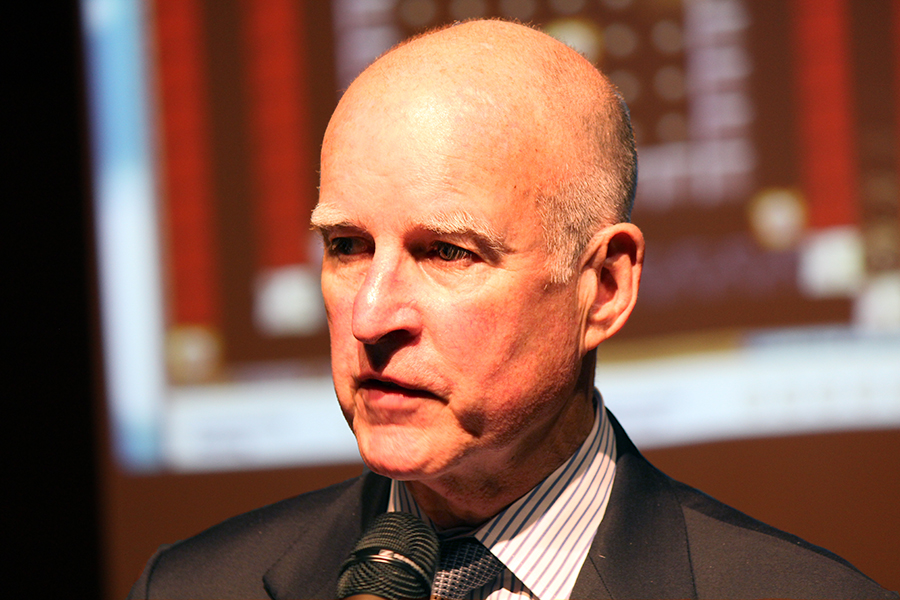
Gov. Jerry Brown
 Credit: Lillian Mongeau for EdSource Today
Gov. Jerry Dark-brown
This story was updated on Oct. 12 to include Gov. Jerry Brown's actions on October. 11, the deadline for him to sign or veto bills.
In recent days, Gov. Jerry Brown has signed or vetoed some of the remaining bills the state Legislature approved during the 2022 session, including legislation that suspends the high school exit exam, creates new rules for placing high school students in math classes, and increases support for foster students in California.
On his final day to sign or veto bills, Chocolate-brown vetoed a bill that would have required the California Department of Instruction to provide four hours of training to family unit child-care providers in land-subsidized programs, saying in his veto bulletin that the measure was premature in anticipating changes in federal child care laws.
This was the get-go of a two-twelvemonth legislative session, and then some bills that stalled this year – including those that would change teacher evaluations and lift the cap on districts' budget reserves – volition be back next year. Here's what happened to the central education bills EdSource has been tracking.
Signed by the governor
High school exit exam interruption: SB 172, authored past Sen. Carol Liu, D-La Cañada Flintridge, addresses the hereafter and the past of the California High School Exit Exam, or CAHSEE, which has been a graduation requirement starting with the Class of 2006. The new law allows onetime high schoolhouse students who failed the exam every bit far dorsum as 2006 be awarded diplomas, every bit long every bit they passed all of their required classes. It also suspends the test as a graduation requirement for the 2015-xvi, 2016-17 and 2017-18 schoolhouse years. That gives educators and lawmakers time to decide whether to require a new exam or use other measures for graduation. The law goes into effect Jan. 1, which means onetime students can contact their districts next twelvemonth nigh getting their diplomas. Come across frequently asked questions about the exit exam from EdSource and the California Department of Pedagogy.
In August, Dark-brown signed a related beak that allows seniors from the Class of 2022 to graduate if they didn't pass the exam. The emergency legislation went through later on the July exam was cancelled, giving seniors who had failed the exam no chance to retake it.
Vaccination requirements: California has a new vaccination law, effective July ane, 2016, that says parents can no longer refuse to vaccinate their children in public or private schools based on their personal opposition. Gov. Jerry Brown signed the law (SB 277), authored by Sen. Richard Pan, D-Sacramento, and Sen. Ben Allen, D-Santa Monica, on June thirty. The elimination of vaccine opt-outs affects the small number of students – two.v percent of kindergartners statewide in 2022 – who hold a personal conventionalities exemption to babyhood vaccinations required for school enrollment. Under the new police force, children may keep to obtain from a physician a medical exemption to vaccinations.
Math placement: The California Mathematics Placement Human action (SB 359), authored by Sen. Holly Mitchell, D-Los Angeles, was passed with pupil equity in mind: to ensure that capable students aren't assigned less-enervating courses. The new law, which takes issue January. 1, 2016, will require districts to prefer "a fair, objective, and transparent" set of criteria, such equally test scores and grades, for placing students in ninth-class math courses. Districts would exist required to analyze data to ensure that students haven't been misassigned because of their race, ethnicity, gender or socioeconomic groundwork. Each school would have to check during the outset month of the schoolhouse twelvemonth to verify that a student has been assigned appropriately.
The Silicon Valley Customs Foundation sponsored the bill in response to 2010 inquiry by the Noyce Foundation that found capable minority students were held back from Algebra courses in 9th grade, taking them off the trajectory for access to UC schools. "The Governor's action marks a significant victory for everyone involved in working to stop the disturbing practice of math misplacement in our schools," said Emmett Carson, president and CEO of the Silicon Valley Community Foundation, said afterward Brownish signed the bill.
Dual enrollment:Gov. Jerry Brown rarely comments on bills that he signs merely was effusivein a bulletin praising AB 288, which would expand opportunities for agreements establishing dual enrollment, in which loftier schoolhouse students meantime have community higher courses. "I believe these flexible, locally based arrangements will be useful," Brown wrote, "and I encourage local governing boards to consider these dual enrollment partnerships equally they work to ameliorate pupil success" and the time information technology takes to earn a degree.
The beak, by Assemblyman Chris Holden, D-Pasadena, would expand high schoolhouse students' admission to community college courses when high school districts and local customs colleges have formed partnerships. The agreements would have to focus on creating career-technical pathways and establishing remediation courses preparing students for higher. Supporters say that dual enrollment increases the odds of college graduation.
Also of note: AB 889, by Assemblywoman Ling-Ling Chang, R-Diamond Bar, would have expanded dual enrollment in Science, Technology, Engineering science and Math (STEM) courses. AB 889 died in the Assembly Appropriations Committee in May.
Instructional fourth dimension: School districts in California will no longer be allowed to enroll 9th- to 12th-grade students in classes with no educational content, to transport students home early because in that location was no class for them, or crave students to re-take a grade they accept passed, under AB 1012, authored by Assemblyman Reginald Byron Jones-Sawyer Sr., D-South Los Angeles, and signed into police force by Gov. Jerry Brown. School districts had maintained that logistical bug and teacher shortages resulted in gaps in student schedules.
Beginning with the 2016-17 schoolhouse year, school districts are prohibited from assigning students to courses with no educational content for more than i calendar week per semester. Students may not be assigned to a grade they have previously completed with a grade sufficient for application to the California public higher pedagogy system unless the class is designed to be taken more than once and presents new fabric.
Increased support for foster students: Assembly Neb 854, which takes outcome this school year, makes Foster Youth Services available to all children in foster care. Foster Youth Services is a statewide plan administered through county offices of education that offers counseling and tutoring services. Previously, children living with relatives were not eligible for these services. Authored by Assemblywoman Shirley Weber, D-San Diego, AB 854 also requires Foster Youth Services to focus on coordinating services for students – including for the first fourth dimension working with postsecondary education institutions such equally colleges and apprenticeship programs to aid youth transition from foster care into adulthood.
The law too changes the funding formula, which now supports existing programs. Start in 2016-17, county offices of education volition utilise for Foster Youth Services grants based on an allocation system to be developed this school yr by the California Section of Education. Dedicated funding for the program increased from $15 one thousand thousand to $25 million in the 2015-xvi budget.
Vetoed by the governor
Preschool expansion: The Preschool for All Act (AB 47), authored by Assemblyman Kevin McCarty, D-Sacramento, passed with bipartisan support, but failed to get bankroll from Chocolate-brown. The bill would accept ready a deadline of June 30, 2022 for granting all depression-income 4-twelvemonth-olds access to transitional kindergarten or state preschool. Information technology was meant to firm upward a promise made in terminal year'southward legislation (SB 837) that set the eventual goal of providing pre-kindergarten schooling for all depression-income 4-yr-olds. Considering of that previous delivery, Brown said in his veto message that the bill was unnecessary and that hereafter preschool funding should be addressed in the budget-setting process.
AB 47 had no money attached to information technology and was contingent on money available in future budgets. Cost estimates varied profoundly, ranging betwixt $147 meg and $240 million, depending on how many children are placed in full-day vs. half-solar day programs. Betwixt 32,000 and 35,000 low-income 4-year-olds lack access to land preschool, transitional kindergarten or federal Caput Start programs.
Preparation new teachers: Citing the burden of creating a state mandate costing more than $100 million annually, Brown vetoed Assembly Beak 141, past Assemblywoman Susan Bonilla, D-Concord. It would have required those districts choosing to offer the teacher grooming and mentoring programme, called Beginning Teacher Support and Assessment (BTSA), to provide it without charge.
The state mandates that new teachers accept BTSA or an alternative training program like it in order to receive a full or "clear" pedagogy credential. For years, the land funded districts' BTSA programs, but every bit part of massive cuts in spending in 2009, legislators eliminated reimbursements to districts and made providing BTSA optional. Since and then, some districts have been charging teachers an average of $2,500 for the two-year program.
An earlier version of AB 141 would have required all districts to provide BTSA for free, but the final version left the decision of whether to offer it upward to districts, creating the possibility that teachers would have had to obtain a more expensive training program through a college or academy.
The electric current state budget includes $490 1000000 that Brown and the Legislature indicated should be used for teacher training programs over the next three years – although, under local command, districts have the flexibility to spend the money for any purpose they choose. "Part of this funding should be used to support new teachers. Creating a new mandate is not the answer," Brownish wrote in his veto message.
Besides of note: Not headed to the governor is Senate Beak 62, which would have restored funding for Assumption Plan of Loans for Educators, or APLE, a loan programme that forgave $11,000 or more than in college loans if a new teacher agreed to teach for four years in a hard-to-staff school. The state budget included no money for APLE, and the author of SB 62, Sen. Fran Pavley, D-Agoura Hills, plans to reintroduce the bill next yr.
For-turn a profit charter schools: The performance of for-profit charter schools will proceed in California with Gov. Jerry Brown's veto of AB 787, by Assemblyman Roger Hernández, D-Due west Covina. In a veto message, Brown said, "I don't believe the case has been made to eliminate for-profit charter schools in California." He added that the "somewhat ambiguous terms" used in the bill could be interpreted to restrict the ability of non-profit charter schools to keep using for-profit vendors. Restricting for-profit vendors, such as the Virginia-based for-turn a profit visitor K12 Inc., had been the focus of legislative hearings on the bill just was non explicitly stated in the legislation.
Training for family kid-care providers: Senate Bill 548, authored by Senate President pro Tem Kevin de León, would have required the California Section of Education to provide a four-hour training to family child-care providers in state-subsidized programs that would have covered navigating the state's child-intendance organisation, wellness and safety requirements, federal regulations and an introduction to California's early learning curriculum. In his veto message, Brown said the pecker "prematurely anticipates" what will be required nether upcoming changes in federal child care laws. He said he would straight the state agencies involved to review whatsoever changes in federal police and determine whatsoever need for training.
Dead for the yr
Cap on budget reserves: There was much sound and fury just, in the end, no movement frontward on the endeavour to rescind or at to the lowest degree soften the limit on the rainy-solar day reserves that school districts could concur for emergencies and for future spending. The cap would be tied to those years when the country put money into a new Grand-12 rainy day fund. A Republican-led effort to repeal the cap through SB 774, sponsored by Sen. Jean Fuller, R-Bakersfield, got no traction, and a late-session push past a coalition led by the California Schoolhouse Boards Clan, through SB 799, to heighten the cap and remove information technology for pocket-size districts sputtered in the endmost days of the legislative session.
Teacher evaluations: There was an all-out try early in the year by lawmakers in both parties to revise the teacher tenure law known as the Stull Human action, with Business firm Speaker Toni Atkins, D-San Diego, and Senate President pro Tem Kevin de León, D-Los Angeles, signing on as co-sponsors of almost identical bills, SB 499 and AB 575. But disagreement over how much say teachers should have in determining what criteria to use to evaluate them – a perennial bespeak of contention – stalled action this twelvemonth. Talks will go on with promise for a deal next year, said a spokesman for Sen. Ballad Liu, co-sponsor of SB 499.
Also of note: A Republican instructor evaluation beak, AB 1078, by Assemblywoman Kristin Olsen, R-Modesto, also would have rewritten the Stull Act to crave annual teacher reviews using four evaluation categories, instead of the electric current pass-fail organisation, with incentives to include the utilise of standardized test scores as a factor. It died in commission.
AB 1184, by Assemblywoman Nora Campos, D-San Jose, would have permitted a third yr of probation before a conclusion on instructor tenure specifically for San Jose Unified, whose teachers wedlock and school board had negotiated the provision. Under current constabulary, tenure decisions are made later on just 18 months, although the Superior Courtroom judge in the Vergara 5. State of California lawsuit last year struck down that statute; his ruling is under appeal. AB 1184 failed to move this twelvemonth and volition be reintroduced in the next legislative session.
School transportation: The Local Control Funding Formula froze an inequitable formula for school transportation at 2012-13 levels, with some districts getting 10 percent of their costs covered, while others get eighty percent. SB 191 would fund 50 pct of busing costs for all districts past 2021-22. This yr's budget included no actress money, and then author Marty Block, D-San Diego, will be dorsum pushing the bill next year.
Money for Mutual Cadre: Assemblywoman Susan Bonilla, D-Agree, didn't go precisely what she proposed under AB 631: an boosted $900 million in i-time funding to implement the Mutual Core State Standards. Merely this year's country budget does include $three billion in one-fourth dimension expenditures that Gov. Brown encourages – merely does not require – districts to spend on implementing the new academic standards. An additional $500 one thousand thousand must be spent on improving teacher quality and effectiveness, which districts can use for professional development in the Common Cadre and Side by side Generation Science Standards.
Afterwards-school plan funding: After the governor and legislators failed to include additional funding for after-schoolhouse programs in the 2015-16 budget, Senate Neb 645 never made it out of the appropriations committee. The nib, authored past Sen. Loni Hancock, D-Berkeley, would have increased funding for the land's After School Pedagogy and Safety Program by $54 1000000 in 2015-16 and $72 million plus cost-of-living adjustments annually thereafter. Advocates argued that stagnant funding since the $550 million program began in 2006 is making information technology difficult for subsequently-school programs to attract high-quality staff and proceed to serve the same number of students, and the need to offer programs in areas of the country that are non served.
Charter school bailiwick: Charter schools are exempt from most laws that govern schoolhouse districts, simply they would accept had to comply with disciplinary procedures similar to those used in district schools under the terms of SB 322, authored by Sen. Mark Leno, D-San Francisco. Supporters of the pecker, including the California Teachers Association and the American Ceremonious Liberties Union, alleged that students at some charter schools have been expelled for minor infractions and take not been informed of their right to a fair hearing. Opponents, including the California Charter School Association Advocates, said students receive due procedure at charter schools and that the schools have the right to design their own suspension and expulsion policies. The bill also would have modified preferences in charter schoolhouse admissions to ensure they do not limit enrollment for students with disabilities, students from depression-income families or English learners.
AP course expansion: AB 252, authored by Assemblyman Chris Holden, D-Pasadena, would have created the Advanced Placement Stem Admission Grant Program, which would take provided up to $8,000 in grants to eligible loftier schools to help cover the costs of creating or expanding AP courses in science, technology, applied science and math. The beak aimed to boost the number of female, African-American and Latino students, who have traditionally enrolled in AP courses in biological science, chemistry, calculus, physics, computer science and statistics at lower rates than other student groups. The nib stalled in the Senate Appropriations Committee afterward the author and the committee members indicated they wanted to discuss the neb farther.
To get more reports like this i, click hither to sign up for EdSource's no-cost daily electronic mail on latest developments in educational activity.
thompsonsemnince1944.blogspot.com
Source: https://edsource.org/2015/gov-brown-must-decide-fate-of-exit-exam-other-key-ed-bills/87493
0 Response to "Gov. Brown signs, vetoes key education legislation in days before deadline"
Publicar un comentario